Pages

Thursday, 16 September 2010

Along Pentre-chwyth Road

I thought I'd have look along the banks and habitats that runs along Pentre-chwyth Road.

I found a few things here today but first of all I had to conquer a slight self conciousness I have about appearing to vanish into the bushes for no apparent reason as cars drive by. Last year a car stopped and someone actually asked me what I was 'up to'. As if they had nothing better to do on a busy road.

There's a variety of trees and grassy areas, some of which are slighty boggy. This road isn't used by pedestrians much and so the mushrooms tend to grow undisturbed.
In the past I've found several species of fungi here: Cortinarius, Russula, Mycena, Tricholoma, Stropharia, Hygrocybe, Lactarius to name just a few.

Before I started I found many Fly Agarics down Kilvey Road. This mushroom never fails to excite me and I'm glad that this area has now been colonised by this fungi.

Below is the same Amanita muscaria/Fly Agaric, the photos just show the development over 24 hours..


I find mostly Cortinarius but I also find a new Russula species I've never seen before: Russula aeruginea/Green Russula. The photos of it below don't really do it justice as the green is a subtle olive/terra verte shade.

Three of the Cortinarius I found..

There was also a Tricholoma. It was a Tricholoma scalpturatum/Yellowing Knight. In the first two photos below are what I found on Pentre-chwyth Road. The last two photos are from the pathway that leads to the Pluck.


What do fungi look like?
Fungi look like thin filaments called hyphae. The photo below shows dense white threads in the soil. When hyphae lenghten they become what's called mycelium. These are hyphae that's basically woven together into something denser. As the fungi grows so the mycelium spreads. In 'fairy rings', the fungi is growing outwards, like a ripple over water.
When the fungi is ready to reproduce, certain hyphae in charge of reproduction bond together to create a mushroom. Sometimes when you pick a mushroom the mycelium can still be attached to it's base.

Wednesday, 15 September 2010

Two hours on Kilvey Hill

After a few days of very heavy rain the weather clears and I go up Kilvey Hill from Port Tennant side. I have a quick swoop of Jersey park and there are a few things about. The most conspicuous are Psatheralla growing in the grass but there are two sorts of Inkcaps here too.


Below is a mushroom I can't identify as of yet.


I find one Amanita muscaria on my way up. It's the first I've seen in this location this year.

On the way there are still False Cantrelles about and, at last, Russula ochroleuca. Up at the transmitters, R. ochroleuca match the numbers that I saw in the wooded area at the Pluck.

To my surprise Amanita rubescens has started fruiting in numbers again. I thought their season was virtually over.
Passing the transmitters I come across Sulphur Tuft but also Conifer Tuft which is far less common. It's not the only orange toadstool on coniferous wood chippings and logs either; there's another I don't recognise. It looks like a Rustgill if it's gills are anything to go by. Below is Conifer tuft...


Below is Sulphur Tuft.Conifer tuft, growing out of wood.


Below one can clearly see the difference in the colour of the gills between the tufts. Sulphur Tuft on the left, Conifer Tuft on the right.

Below is the Gymnoplius penetrans/Common Rustgill


Birch Bolete and The Deceiver have both reasserted themselves too and I also find some Tricholoma fulvum/Birch Knight. I found this on Sunday but it's taken today before I could positively identify it.

Amongst the moss and needles was a Mycena. I have problems with this mushroom species however this on was reasonably easy because of the smell it has. Basically it smells of amonia and swimming pools; it's called Mycena alcalina.


There are a few nice new discoveries today, Including a new Lactarius: Lactarius glyciosmus/ Coconut Milkcap and it does smell strongly of coconut too.

There's a few other things for me to scratch my head over including a dainty little mushroom with a white stipe and gills and a distinct pink cap. It's not a Russula however. that much is clear to me. The stipe is completely different to Russula.


I found the above mushroom on Pentre-chwyth Road as well as a few other things. I think I might do a foray along this road sometime next week as it has been supplying me with a wealth of mushrooms now. Many of them are new to me so it deserves further attention.

Below, Panaelous papilionaceus/Bell-shaped Mottlegill growing on horse dung.


Jersey Park
Coprinopsis atramentaria/Common Inkcap
Coprinellus disseminatus/Fairy Inkcap
Psathyrella candolleana/Pale Britlestem
Hygrocybe conica
/Blackening Waxcap

Kilvey Hill
Amanita muscaria/Fly Agaric
Amanita muscaria/The Blusher
Hygrophoropsis aurantiaca/False Chanterelle
Hypholoma fasciculare/Sulphur Tuft
Hypholoma capnoides/Conifer Tuft
Mycena alcalina
Tricholoma fulvum/Birch Knight
Lactarius glyciosmus/Coconut Milkcap
Laccaria laccata/The Deceiver
Panaelous papilionaceus/Bell-shaped Mottlegill
Gymnopilus sapiens/Scaly Rustgill
Rickenella fibula/Orange Mosscap
Cortinarius (unknown)
Hebeloma crustuliniforme/Poisonpie

Pentre-chwyth Road
Unknown

Tuesday, 14 September 2010

Back to Clyne Woods

The rain was drumming but I went to Clyne woods anyway, to see if anything had fruited but to my dismay it was as bare as previously. That's not to say there was nothing but I hoped that the weather would have given the ground a good soaking resulting in mushrooms everywhere.

Strangely, there were two small diggers tearing up the soil, which surely has damaged the earth and crushed fungi. I guess they were making pathways. The wood is a mud bath so I'm glad I took my wellies. There's already plenty of ramps for mountain bikers to fling themselves into the air.


What I did find was fungi on wood: Panellus stipticus/Bitter Oysterling (below), Stereum hirsutum/Hairy Curtaincrust and some Postia stiptica/Bitter Bracket.

After finding very little I did find a Russula on my way back down.

After Clyne I traipse back home along the cycle/pedestrian path that goes all the way back to town. It reveals a lot more fungi than the wood.

On the golf course there's a large fairy ring, made from Marasmius oreades/Fairy Ring Champignon.
Under a pine tree I find this little mushroom but I don't identify it.


Further down the pathway there's some Hebeloma crustuliniforme/Poisonpie (below), in the banks and further along the path in the grass some other mushrooms.

Laccaria laccata/The Deceiver.
Lyophyllum descates/Chicken Mushroom/Clustered Domecap. This particular mushroom is easy to identify because it grows in tight clumps. It's cap is a chocolate brown colour and the gills lighter.

When I get to the council offices, which is opposite the prison, I find quite a lot of species growing in the grass on the banks there, all in the same area. The trees here are evergreens.
Below:
Hygrocybe persistens.

Clitocybe gibba/Common Funnel.Russula sanguinaria.

Conocybe tenera.Melanoleuca polioleuca.This Inocybe I can't identify.When I sliced though the flesh there was a very faint purple flush at the top, where the stipe meets the cap, (see below).


Clyne Wood 13-9-10

Panellus stipticus/Bitter Oysterling
Stereum hirsutum/Hairy Curtaincrust
Postia stiptica/Bitter Bracket
Marasmius oreades/Fairy Ring Champignon.
Hebeloma crustuliniforme/Poisonpie
Laccaria laccata/The Deceiver
Lyophyllum descates/Chicken Mushroom/Clustered Domecap
Clitocybe gibba/Common Funnel
Russula sanguinaria
Melanoleuca polioleuca
Conocybe tenera

1 Inocybe & 1 Russula
1 unknown

Sunday, 12 September 2010

1 Hour Kilvey Foray

I took a quick foray up Kilvey hill via the Pentre-chwyth Rd entrance taking the same route as ten days or so ago. My last few trips there have been slightly disappointing in regards to finding mushrooms.
It rained all day Friday with no let up then the weather cleared. I hoped that the relentless downpour then finer days would make the fungi come out. It did.
At the top of the hill I came across Suillus grevillei/Larch boletes in numbers I have never seen before.


It wasn't the only Suillus here though; not far away the Suillus leteus/Slippery Jacks I had seen before had also come out in force, their slimy caps glistening in the sunlight.
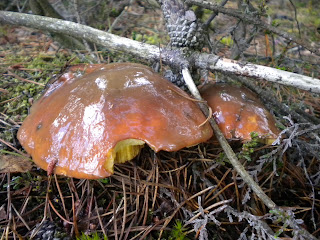
I take a path off the main one to find more boletes but also Russula ochroleuca in great numbers. This isn't unusual but they seemed to have fruited later than usual. Tardiness aside, they cover the forest floor as far as the eye can see, transforming the wood into something akin to a fairytale scene.

Butterflies and dragonflies dance about and hover flies zip around chasing off rivals before resuming their duty to hang as still in space between the trees.

At the base of these trees I find some new mushrooms; two Cortinarius to be precise though precisely which ones, well that's a different matter. I take a couple of them. Even though they are hard to identify I never get put off trying.
There's also a lone Russula close by too, it's bright white stipe and red cap looking like a beacon.

Deciding to take a half trodden path across the forest floor, which on Kilvey hill isn't always sensible; some of the terrain can be treacherous with deep pot holes full of water but this time I'm more cautious and it's okay and on the way find more Cortinarius that I saw previously and also Calocera cornea/Small Staghorn (below), on the base of a dead birch log as well as staples of most woods such as Sulphur Tuft, False Chanterelles and Plums and Custard.


I end up on a main path that leads up to a little pond and head in that direction to a specific part of the hill in the hope that I'll find a particular Tricholoma that I've seen before but on the way something catches my eye. It turns out to be a saw. My curiosity is rewarded however when near by is a mushroom I've never seen before. I don't know what it is.

It's growing in numbers so I take a few in different stages of development, I hope this will give me a better chance of identifying it.

When I get to where I want there are no Tricholomas about but there is a bracket fungi that interests me; Trichaptum abietinum/Purplepore Bracket. (= Hirschioporus abientinus).


I head back down the hill as a rain shower begins and find a few things on the way, most of which I cannot identify but one is definitely a Hebeloma; it's gills are a give away. Below is one of the unknown mushrooms.

Pentre-chwyth Road and Home.
After finishing that circuit I feel like having a quick check around Pentre-chwyth Road and find another Cortinarius and a couple of more unknown toadstools on the bank next to the main road. As I pick them my backside appears to be sticking out of a bush whilst cars whizz by, the looks I get from drivers and passengers is mildly amusing. The occasional wit parps his horn.


Crossing over to the other side there are plenty of Brown Rollrims about, some are enormous.

I head back home and find yet another Cortinarius, under pine trees, high up a bank so I scrabble up and collect a couple. One of them shows evidence of geotropism (below).

Suddenly the heavens open and heavy shower begins. Whilst waiting for the rain to ease under the trees I see an Amanita muscaria/Fly agaric. It's reassuring to know that this particular fungi is now growing here. It puts a smile on my face regardless of the rain.

Kilvey Hill 12-9-10
Leccinum scabrum/Birch Bolete
Russula emetica/The Sickener
Russula ochroleuca/Ochre Brittlegill
Russula betularum/Birch Brittlegill
Hypholoma fasciculare/Suplhur Tuft
Hygrophoropsis aurantiaca/False Chanterelle
Tricholomoposis rutilans/Plums & Custard
Amanita rubescens/The Blusher
Amanita muscaria/Fly Agaric
Suillus leteus/Slippery Jack
Suillus grevillei/Larch Bolete
Paxillus involutus/Brown Rollrim
Lactarius pubescens/Bearded Milkcap
Calocera cornea/Small Staghorn
Trichaptum abietinum/Purplepore Bracket. (= Hirschioporus abientinus)
Postia stiptica/Bitter Bracket
Leratiomyces ceres/Redlead Roundhead (= Stopharia aurantiaca)
+ 16 unidentified