Showing posts with label Flammulina velutipes. Show all posts
Wednesday, 14 March 2012
Kilvey Hill. 26th Feb
On the way to kilvey hill, growing on a mound of wood mulch were loads of Stump Puffballs, Lycoperdon pyriforme, (above). I didn't expect to find much but there are always crusts about and other bracket fungi.
Below is Velvet shank, Flammulina velutipes.
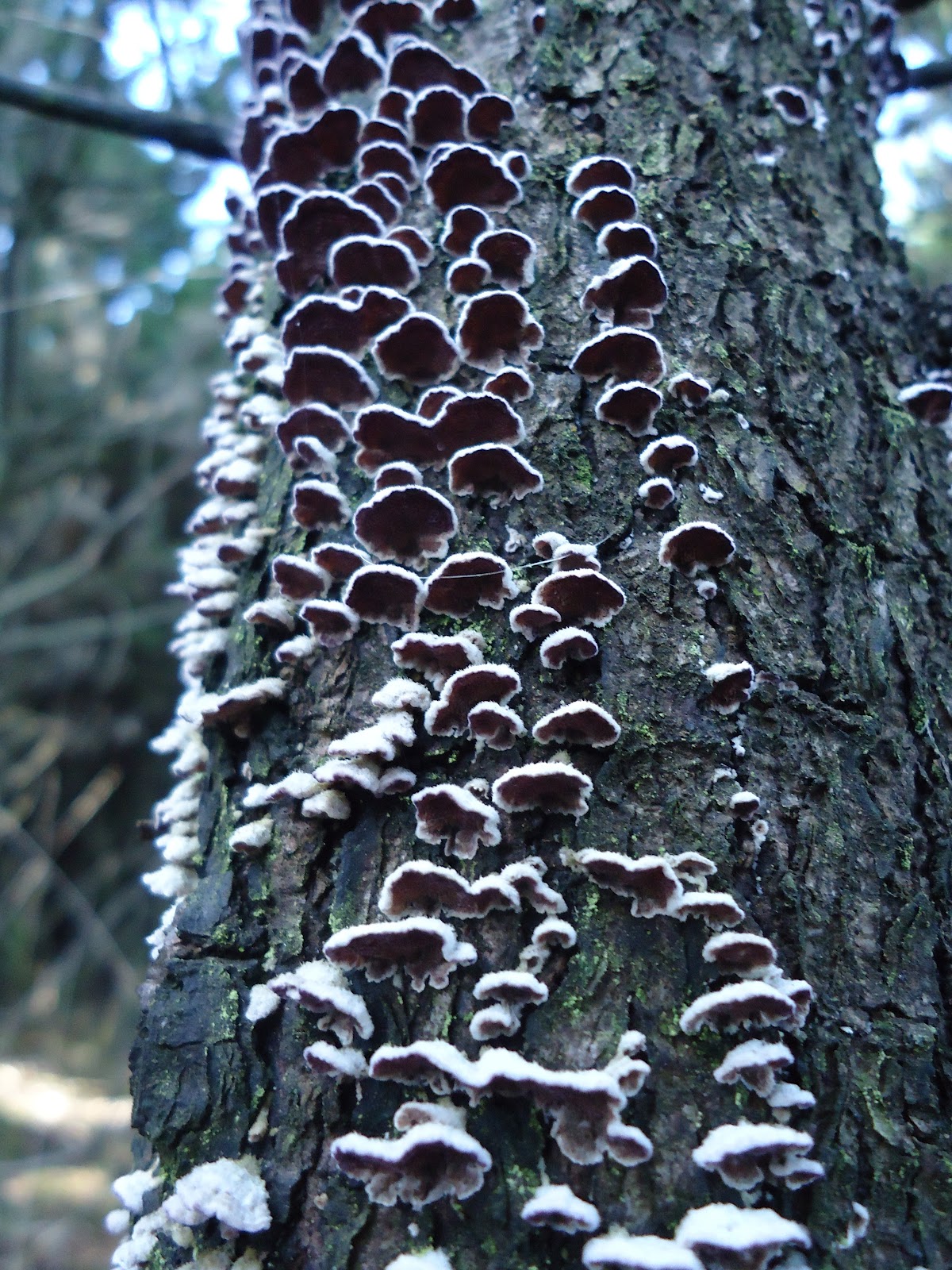
Looking rather healthy was a lovely display of Purplepore Bracket, Trichaptum abietinum. This bracket is easy to identify due to its striking purple pore surface. This becomes more brown with age.
Friday, 9 March 2012
Flammulina velutipes/Velvet Shank
Flammulina velutipes or Velvet Shank to give it its common name is one a handful of fungi that fruit over winter and is easily identifiable.
The cap is a tan-yellow orange that's darker towards the centre. Although there are no photos here, the stalk is yellow at the apex but gets darker towards the base and is very velvety. It lives on decaying deciduous trees.
The first two photos were taken on 24th of February. the second two ten days later and one can see how the mushrooms have matured. These mushrooms are edible but rather flabby in texture and not really worth picking.
The cap is a tan-yellow orange that's darker towards the centre. Although there are no photos here, the stalk is yellow at the apex but gets darker towards the base and is very velvety. It lives on decaying deciduous trees.
The first two photos were taken on 24th of February. the second two ten days later and one can see how the mushrooms have matured. These mushrooms are edible but rather flabby in texture and not really worth picking.
Tuesday, 22 February 2011
Fungi Since the New Year
This isn't the best time of year to see many fungi species but there are always some about. One species in particular; Flammulina velutipes/Velvet Shank is a winter fruiting fungi and very common. It's easy to identify not only because of the time of year it arrives but also its appearance. It's capable of resisting severe frosts, even being frozen and indeed when it thaws out will produce more spores. I've found examples here in Swansea and in Milford Haven.
Flammulina velutipes/Velvet Shank.
It appears in clusters on dead and decaying deciduous trees. The cap is a rich yellowish orange which is usually a darker orange brown in the centre. The edges are paler and faintly striate as can be seen below. When it's wet the cap looks slimy but when dry it has a shiny appearance.
The gills are adnexed and when young are an bright ivory white and mature to a dirty yellow. The sample below shows the mature stage. The stipe is curved and tough and dark brown, slightly lighter or yellowish at the apex and velvety looking.
Another very common species that fruits through autumn and winter is Tubaria furfuracea/Scurfy Twiglet. There's been a large group of them emerging from the soil in a stretch of grass and trees by Sainsburys car park that have lasted almost a month. They're not the most exciting to look at but they can be identified partially because the mushrooms come around this time of the year.
Tubaria furfuracea/Scurfy Twiglet.
This species lives off wood which was beneath the soil. At first one can see small light specks along the edge of the cap which get lost sometimes as the mushroom matures and the cap changes colour from a reddish brown to cream when dry. When moist there are clear striations running from the cap edge inwards.
The gills are an orange/cinnamon colour. As it matures the cap curls inwards.
Below the velar remains on the edge of the cap can clearly be seen in this young specimen.
Below the scurfy appearance of the cap surface and striations around the edge is visible.
As the cap drys it changes from reddish brown to cream. The photo underneath shows the fruitbodies at different stages of drying.
Below is Dacrymyces stillatus/Common Jellyspot. It lives all year round and is very common..
Flammulina velutipes/Velvet Shank.
It appears in clusters on dead and decaying deciduous trees. The cap is a rich yellowish orange which is usually a darker orange brown in the centre. The edges are paler and faintly striate as can be seen below. When it's wet the cap looks slimy but when dry it has a shiny appearance.
The gills are adnexed and when young are an bright ivory white and mature to a dirty yellow. The sample below shows the mature stage. The stipe is curved and tough and dark brown, slightly lighter or yellowish at the apex and velvety looking.
Another very common species that fruits through autumn and winter is Tubaria furfuracea/Scurfy Twiglet. There's been a large group of them emerging from the soil in a stretch of grass and trees by Sainsburys car park that have lasted almost a month. They're not the most exciting to look at but they can be identified partially because the mushrooms come around this time of the year.
Tubaria furfuracea/Scurfy Twiglet.
This species lives off wood which was beneath the soil. At first one can see small light specks along the edge of the cap which get lost sometimes as the mushroom matures and the cap changes colour from a reddish brown to cream when dry. When moist there are clear striations running from the cap edge inwards.
The gills are an orange/cinnamon colour. As it matures the cap curls inwards.
Below the velar remains on the edge of the cap can clearly be seen in this young specimen.
Below the scurfy appearance of the cap surface and striations around the edge is visible.
As the cap drys it changes from reddish brown to cream. The photo underneath shows the fruitbodies at different stages of drying.
Below is Dacrymyces stillatus/Common Jellyspot. It lives all year round and is very common..
Subscribe to:
Posts (Atom)