
It's been very misty all week and Kilvey Hill has vanished under a dense grey shroud. I go for a foray up the hill but I don't predict to find much, if anything.
Even after five days of heavy mist the woodland floor is clearly dry. For the most part my own prediction comes true but I'm satisfied all the same when I come across two fungi fruiting in within metres of each other.
Halfway over the route I decided to take today I come across a tree covered with Coprinellus disseminatus, Fairy Inkcaps. This particular Inkcap is easy to identify because it can fruit in spectacular numbers. Coprinellus disseminatus is a fungi that creates small, fragile mushrooms, often in swarms covering dead trees and wood.
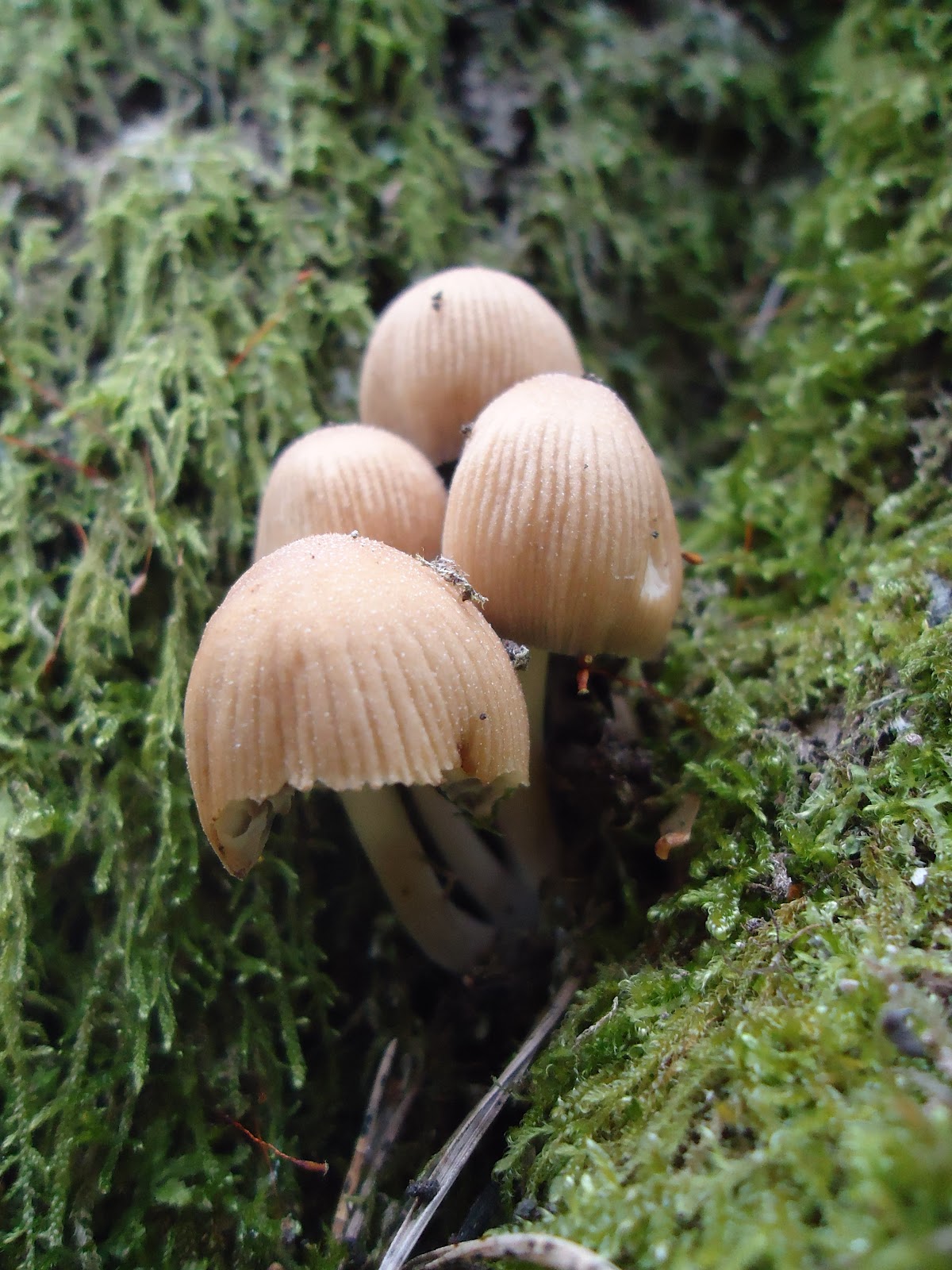
The cap is 'striate': one can see lines running from the edge towards the top of the cap. It looks oval at first then bell shaped then convex. It's worth noting that one can see ageing. Fresh mushrooms are creamy buff but they turn grey as they mature and the cap turns from bell shaped to flattening out.


The fantastic display is over quickly but it's worth seeing the mushrooms in different stages of maturity because one can see the difference and learn from that.

A few metres away was a Daedaleopsis confragosa, Blushing Bracket. This particular specimen looked rather healthy and I'm guessing that that all the fruiting bodies belong to one, singular fungi within this branch.


Below is the same fungi but it is young. I found this earlier but I'm sure it's the same thing. I've never seen this fungi at this developmental stage. If one looks at the edge one can see the maroon layers.


Bracket fungi take a long time to mature while Inkcaps take days. It's worth noticing the difference and learning from it.


