A damp misty day.. I felt I better have a look up Kilvey Hill to see what was about. At this time of year the emphasis is on looking for fungi that grows on dead wood and there is plenty of that around on the hill.
Not everything found was a 'bracket', 'crust' or 'curtain' and one in particular was a mystery.
I have to admit that I have generally overlooked these types of fungi in the past. 'Crusts' are not the most photogenic of fungi but under a hand lens their surfaces are transformed into canyons of remarkable intricacy and complexity.
It was not long before I came across mycelium growing on leaf litter and on broken and fallen dead branches.
Dead tree trunks and branches provide nourishment for 'crusts', 'bracket' and 'curtain' fungi. Below is a species I've had some difficulty identifying. The second photo is the same fungi but at a different stage in its development. It could be a number of fungi.
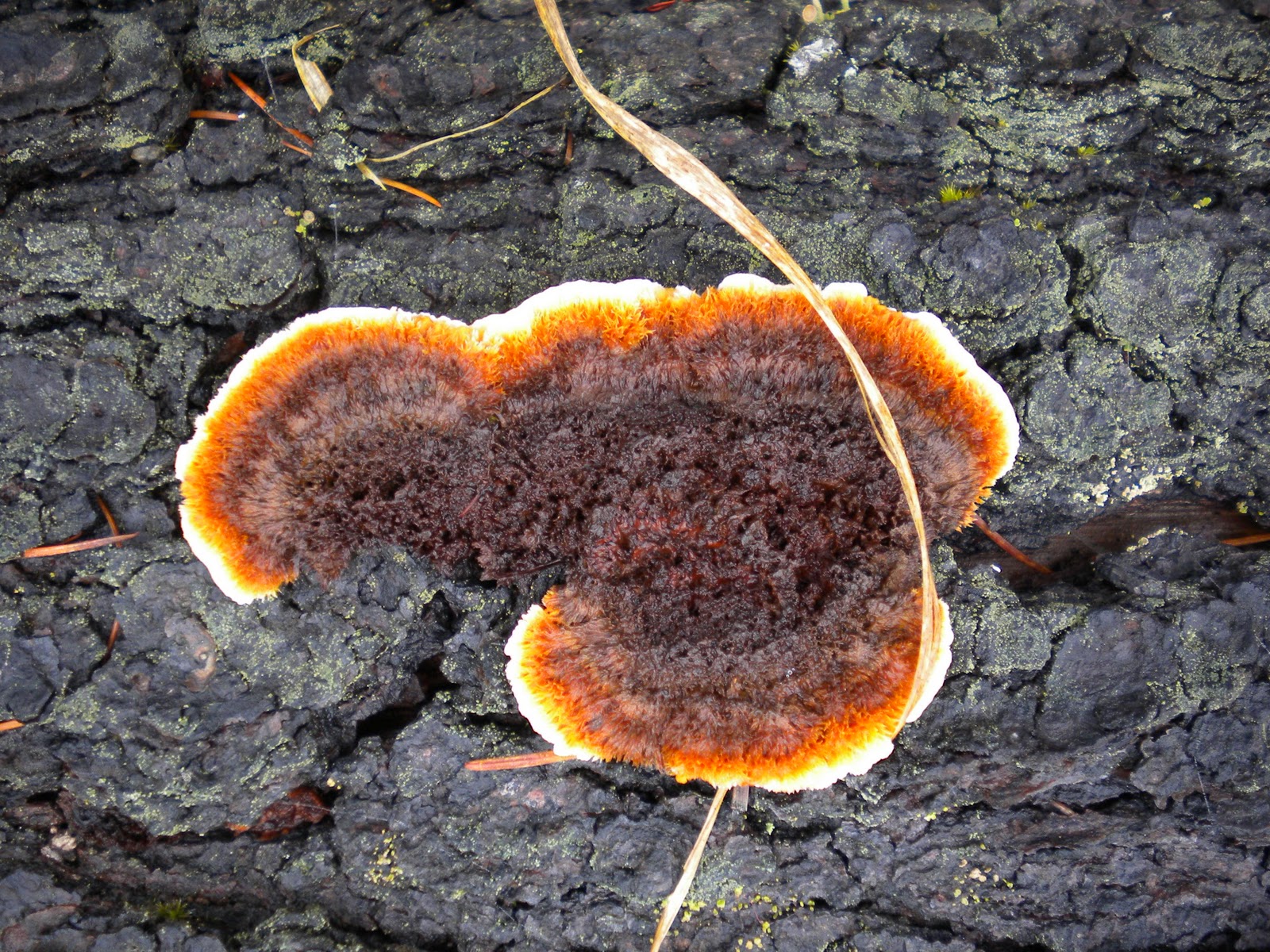
On a felled conifer trunk I came across a fungi I've not encountered on Kilvey before.
Gloeophyllum sepiaruim/Conifer Mazegill.
The fruitbody is attached to the wood by a very short stalk and spreads out, sometimes creating a rosette look. It's maroon in colour and darker in the centre but as can be seen below becomes lighter as it extends outwards becoming very pale at the edge.
Its surface can be slightly felty or hairy to the touch and the common name refers to the pore structure underneath..
On Kilvey Hill there is one particular bracket that is very abundant;
Trichaptum abietinum (=Hirschioporus abientinus) Purplepore Bracket. Its widespread and very common everywhere and very easy to spot due to the purple coloured pore surface, (which turns brown with age). It's fan shaped, up to 5cm across in rows or tiers and can completely cover tree trunks. It grows on fallen and decayed conifer wood.

Another species of fungi out in good numbers was
Tremella mesenterica/Yellow Brain. The
Tremella species are parasitic and they live off the mycelium of another fungi,
Peniphora, (which is a crust fungi).
On my way down the hill towards Port Tennant I come across this unusual looking, jellylike fungi. I think it might belong to the
Tremella family too but I've never seen anything like this before..
In Jersey Park there are two more bracket fungi to find before going home and both are very common. Below is
Bjerkandera adusta/Smoky Bracket..
The pore side of this bracket has a distinct grey colour and when young the margin is white above and below. The fungi has a suede like feel and is leathery tough to the feel.
Below is a rather fine example in the variations of colour produced by
Trametes versicolor/Turkeytail. This one was attached to an old wooden stump in the soil