Showing posts with label Trichaptum abietinum. Show all posts
Wednesday, 14 March 2012
Kilvey Hill. 26th Feb
On the way to kilvey hill, growing on a mound of wood mulch were loads of Stump Puffballs, Lycoperdon pyriforme, (above). I didn't expect to find much but there are always crusts about and other bracket fungi.
Below is Velvet shank, Flammulina velutipes.
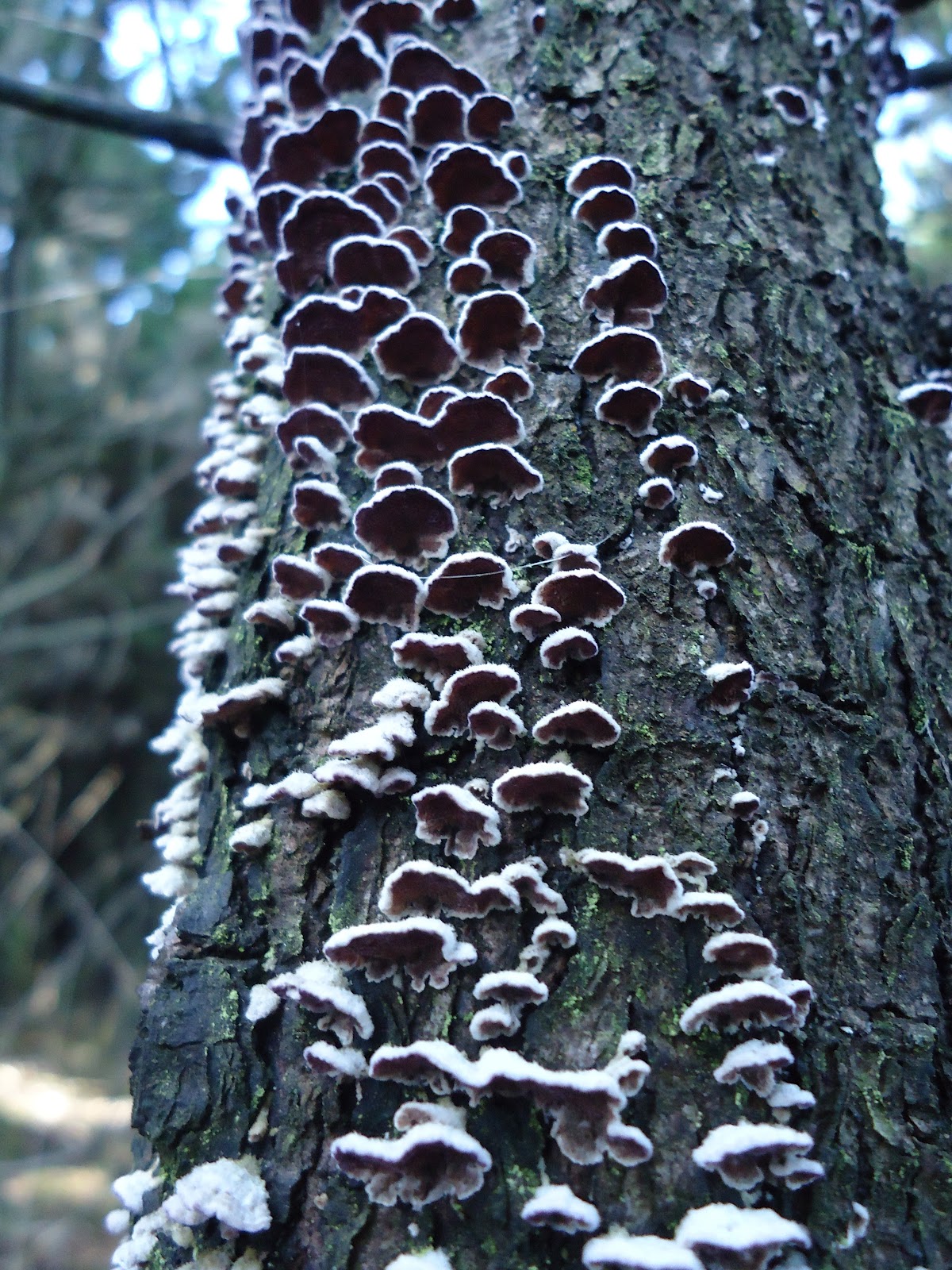
Looking rather healthy was a lovely display of Purplepore Bracket, Trichaptum abietinum. This bracket is easy to identify due to its striking purple pore surface. This becomes more brown with age.
Tuesday, 19 April 2011
The Trembling Brain. Tremella encephala
Earlier this year, up on Kilvey Hill I came across a mushroom I had not seen before. I guessed it was a tremella because of its basic jelly like appearance but it was not a mushroom that I could find in any books but I did find it online and identified it as Tremella encephala.
Tremella is a parasitic species that lives off other fungi. Tremella encephala or trembling brain, to give it a literal description is firm to the touch and indeed it resembles a brain. In the photos above one can also see another mushroom of the Stereum family and online, Stereum sanguinolentum is given as the host species. The bracket shown in these photos however is Trichaptum abietinum/Purplepore Bracket which is a very common species that lives on conifers and it was on conifers that all specimens were found.
The Tremella lives on the mycelium of the species it's parasitic on so quite often the host cannot be seen.
Below is the mushroom seen under a hand lens and beneath that one can see a cross section through the fruitbody. The centre of the mushroom is intriguing. What one is looking at is the deformed fruiting body of the host.
The centre is a firm opaque white core. Click on the photo to enlarge.
One of the qualities of tremella is that they dry up in sunny weather only to re-inflate after rain. Quite a few jelly fungi do this. A month or so after the weather had been very nice I returned and virtually all had disappeared.
The photo below is of the first Tremella encephala I came across and as can be seen, the fruitbody had shrivelled and hardened into a dark crimson nugget.
Below are close up photos of the tubes of Trichaptum abientinum/Purplepore Bracket. The lilac colour is clearly visible. As this mushroom matures the tubes turn from purple to a red brown.
Sunday, 27 February 2011
Kilvey Hill 23-02-11
| On Kilvey Hill with Jersey Park in the background. |
There was also a mushroom growing out of the bottom of a Lodgepole pine (Pinus contorta) on the way..
I had been reading about fungi that live on burnt ground and felt that there might be a possability that something might be there and there was. Below is one of the Peziza family clearly growing out of the burnt earth..
The other fungi I had returned to find was also in the same area and as it turned out was in reasonable numbers. Below is one of the Tremella family.
Amongst the tree stumps were piles of cow dung. There's a farm up here and the cows often roam around. As a result dung fungi appear and below is Stropharia semiglobata/Dung Roundhead, a very common species.
Near by and also very common was another dung fungi; Panaeolus papilionaceus (=P.sphinctrinus)/Petticoat Mottlegill. The common name refers to the veil remnants that hang from the edge of the cap. It's basic appearence is a grey brown and dull or satiny cap that's bell shaped.
Both Stropharia (Roundheads) and Panaeolus (Mottlegills) belong to a large family of fungi called Strophariaceae which also includes the Pholiota (Scalycaps) Hypholoma and Psilocybe (Tufts and Brownie) fungi.
| Panaeolus papilionaceus (=P.sphinctrinus)/Petticoat Mottlegill. |
There are plenty of felled logs on the hill and with them various brackets and crusts. Even though I can't identify these it was worth photographing them anyway. I'll attempt to identify them at some point.
The day before I had found a mushroom that I had never seen before and had spent some time looking for it in books and online. I thought, taking a guess based on its physical appearence alone that it was a Tremella/Jelly Fungus.
What I learnt was that Tremella is a parsitic fungi that lives off other crust fungi, particualarly Stereum and Peniphora and below I found a Tremella amongst Stereum.
Below is another Tremella. Probably Tremella foliacea.
At the base of the logs was Hypholoma fasciculare/Sulphur Tuft which can be found all year round although I've never seen it this early myself.
On the same pile was this beautiful violet crust. (Possibly Terana caerulea/Cobalt Crust). It might be that this is just the early stages of Trichaptum abietnum/Purplepore Bracket which is very common here so I'll keep an eye on this fungi to see how it develops.
Also here was Dacrymyces stillatus/Common Jellyspot
Wednesday, 23 February 2011
Kilvey Hill 22-02-11
A damp misty day.. I felt I better have a look up Kilvey Hill to see what was about. At this time of year the emphasis is on looking for fungi that grows on dead wood and there is plenty of that around on the hill.
Not everything found was a 'bracket', 'crust' or 'curtain' and one in particular was a mystery.
I have to admit that I have generally overlooked these types of fungi in the past. 'Crusts' are not the most photogenic of fungi but under a hand lens their surfaces are transformed into canyons of remarkable intricacy and complexity.
It was not long before I came across mycelium growing on leaf litter and on broken and fallen dead branches.
Dead tree trunks and branches provide nourishment for 'crusts', 'bracket' and 'curtain' fungi. Below is a species I've had some difficulty identifying. The second photo is the same fungi but at a different stage in its development. It could be a number of fungi.
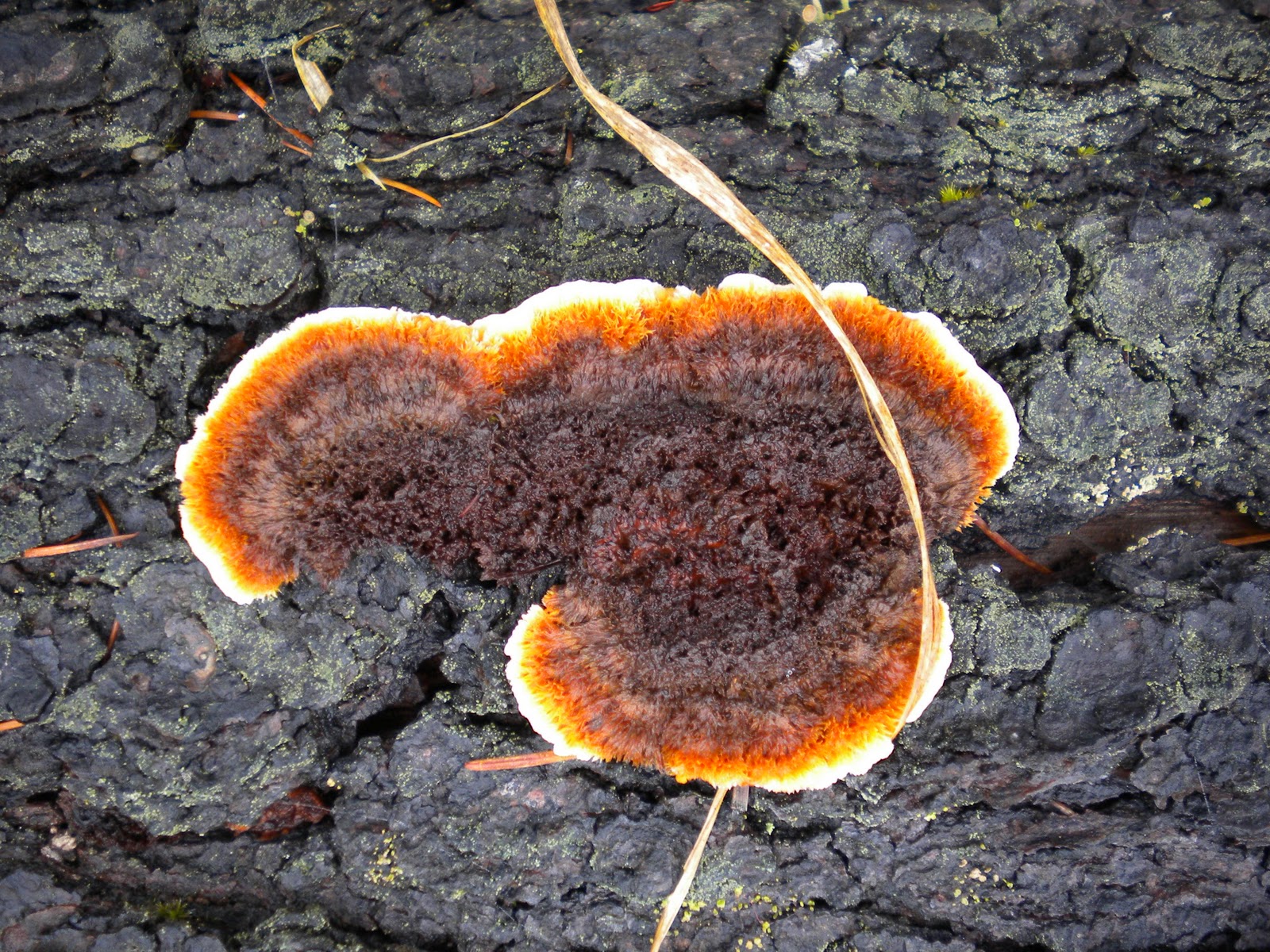
On a felled conifer trunk I came across a fungi I've not encountered on Kilvey before. Gloeophyllum sepiaruim/Conifer Mazegill.
The fruitbody is attached to the wood by a very short stalk and spreads out, sometimes creating a rosette look. It's maroon in colour and darker in the centre but as can be seen below becomes lighter as it extends outwards becoming very pale at the edge.
Its surface can be slightly felty or hairy to the touch and the common name refers to the pore structure underneath..
On Kilvey Hill there is one particular bracket that is very abundant; Trichaptum abietinum (=Hirschioporus abientinus) Purplepore Bracket. Its widespread and very common everywhere and very easy to spot due to the purple coloured pore surface, (which turns brown with age). It's fan shaped, up to 5cm across in rows or tiers and can completely cover tree trunks. It grows on fallen and decayed conifer wood.

Another species of fungi out in good numbers was Tremella mesenterica/Yellow Brain. The Tremella species are parasitic and they live off the mycelium of another fungi, Peniphora, (which is a crust fungi).
On my way down the hill towards Port Tennant I come across this unusual looking, jellylike fungi. I think it might belong to the Tremella family too but I've never seen anything like this before..
In Jersey Park there are two more bracket fungi to find before going home and both are very common. Below is Bjerkandera adusta/Smoky Bracket..
The pore side of this bracket has a distinct grey colour and when young the margin is white above and below. The fungi has a suede like feel and is leathery tough to the feel.
Below is a rather fine example in the variations of colour produced by Trametes versicolor/Turkeytail. This one was attached to an old wooden stump in the soil
Not everything found was a 'bracket', 'crust' or 'curtain' and one in particular was a mystery.
I have to admit that I have generally overlooked these types of fungi in the past. 'Crusts' are not the most photogenic of fungi but under a hand lens their surfaces are transformed into canyons of remarkable intricacy and complexity.
It was not long before I came across mycelium growing on leaf litter and on broken and fallen dead branches.
Dead tree trunks and branches provide nourishment for 'crusts', 'bracket' and 'curtain' fungi. Below is a species I've had some difficulty identifying. The second photo is the same fungi but at a different stage in its development. It could be a number of fungi.
On a felled conifer trunk I came across a fungi I've not encountered on Kilvey before. Gloeophyllum sepiaruim/Conifer Mazegill.
The fruitbody is attached to the wood by a very short stalk and spreads out, sometimes creating a rosette look. It's maroon in colour and darker in the centre but as can be seen below becomes lighter as it extends outwards becoming very pale at the edge.
Its surface can be slightly felty or hairy to the touch and the common name refers to the pore structure underneath..
On Kilvey Hill there is one particular bracket that is very abundant; Trichaptum abietinum (=Hirschioporus abientinus) Purplepore Bracket. Its widespread and very common everywhere and very easy to spot due to the purple coloured pore surface, (which turns brown with age). It's fan shaped, up to 5cm across in rows or tiers and can completely cover tree trunks. It grows on fallen and decayed conifer wood.
Another species of fungi out in good numbers was Tremella mesenterica/Yellow Brain. The Tremella species are parasitic and they live off the mycelium of another fungi, Peniphora, (which is a crust fungi).
On my way down the hill towards Port Tennant I come across this unusual looking, jellylike fungi. I think it might belong to the Tremella family too but I've never seen anything like this before..
In Jersey Park there are two more bracket fungi to find before going home and both are very common. Below is Bjerkandera adusta/Smoky Bracket..
The pore side of this bracket has a distinct grey colour and when young the margin is white above and below. The fungi has a suede like feel and is leathery tough to the feel.
Below is a rather fine example in the variations of colour produced by Trametes versicolor/Turkeytail. This one was attached to an old wooden stump in the soil
Subscribe to:
Posts (Atom)