Friday, 16 March 2012
Kilvey Hill
It's been very misty all week and Kilvey Hill has vanished under a dense grey shroud. I go for a foray up the hill but I don't predict to find much, if anything.
Even after five days of heavy mist the woodland floor is clearly dry. For the most part my own prediction comes true but I'm satisfied all the same when I come across two fungi fruiting in within metres of each other.
Halfway over the route I decided to take today I come across a tree covered with Coprinellus disseminatus, Fairy Inkcaps. This particular Inkcap is easy to identify because it can fruit in spectacular numbers. Coprinellus disseminatus is a fungi that creates small, fragile mushrooms, often in swarms covering dead trees and wood.
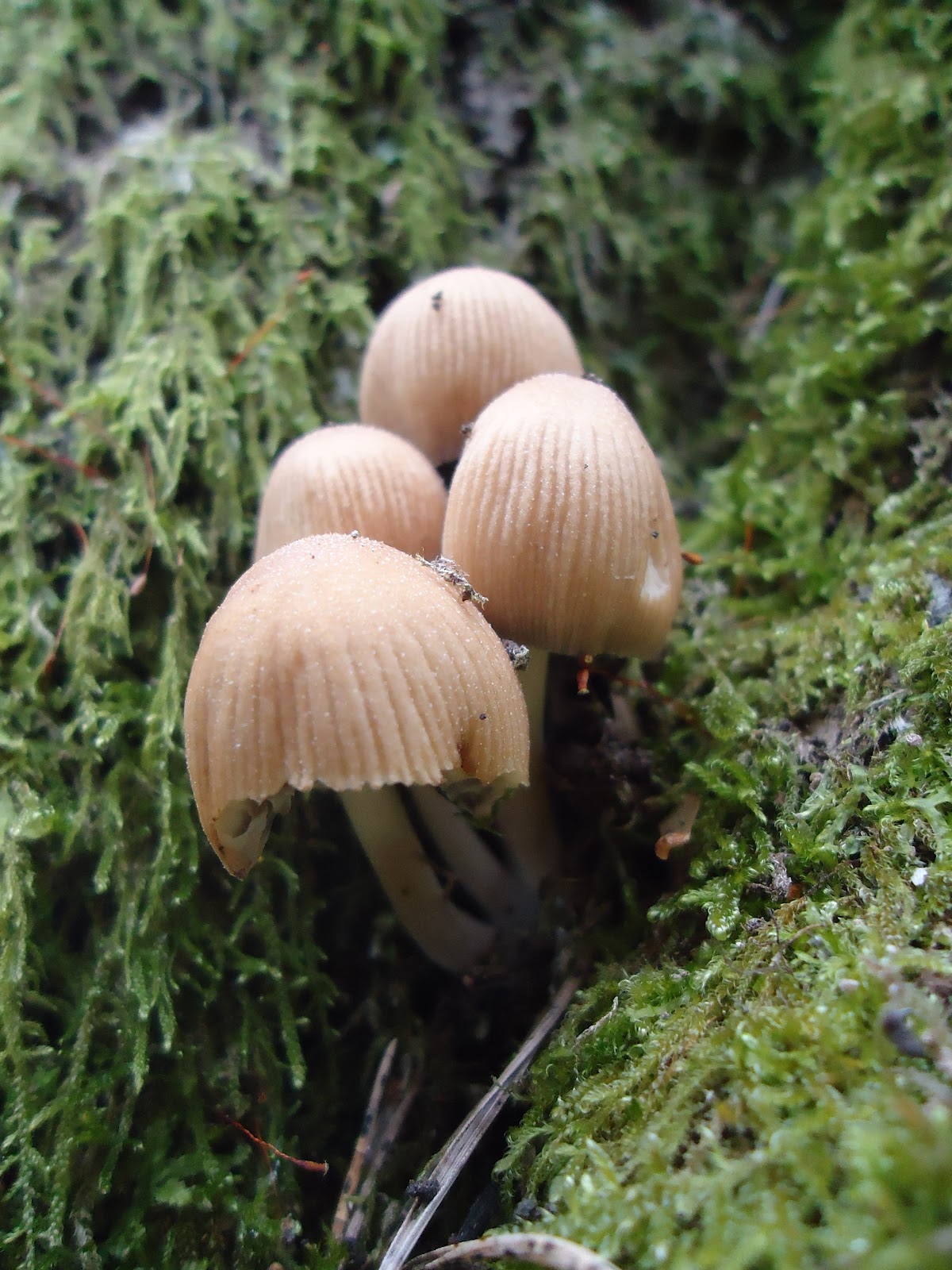
The cap is 'striate': one can see lines running from the edge towards the top of the cap. It looks oval at first then bell shaped then convex. It's worth noting that one can see ageing. Fresh mushrooms are creamy buff but they turn grey as they mature and the cap turns from bell shaped to flattening out.
The fantastic display is over quickly but it's worth seeing the mushrooms in different stages of maturity because one can see the difference and learn from that.
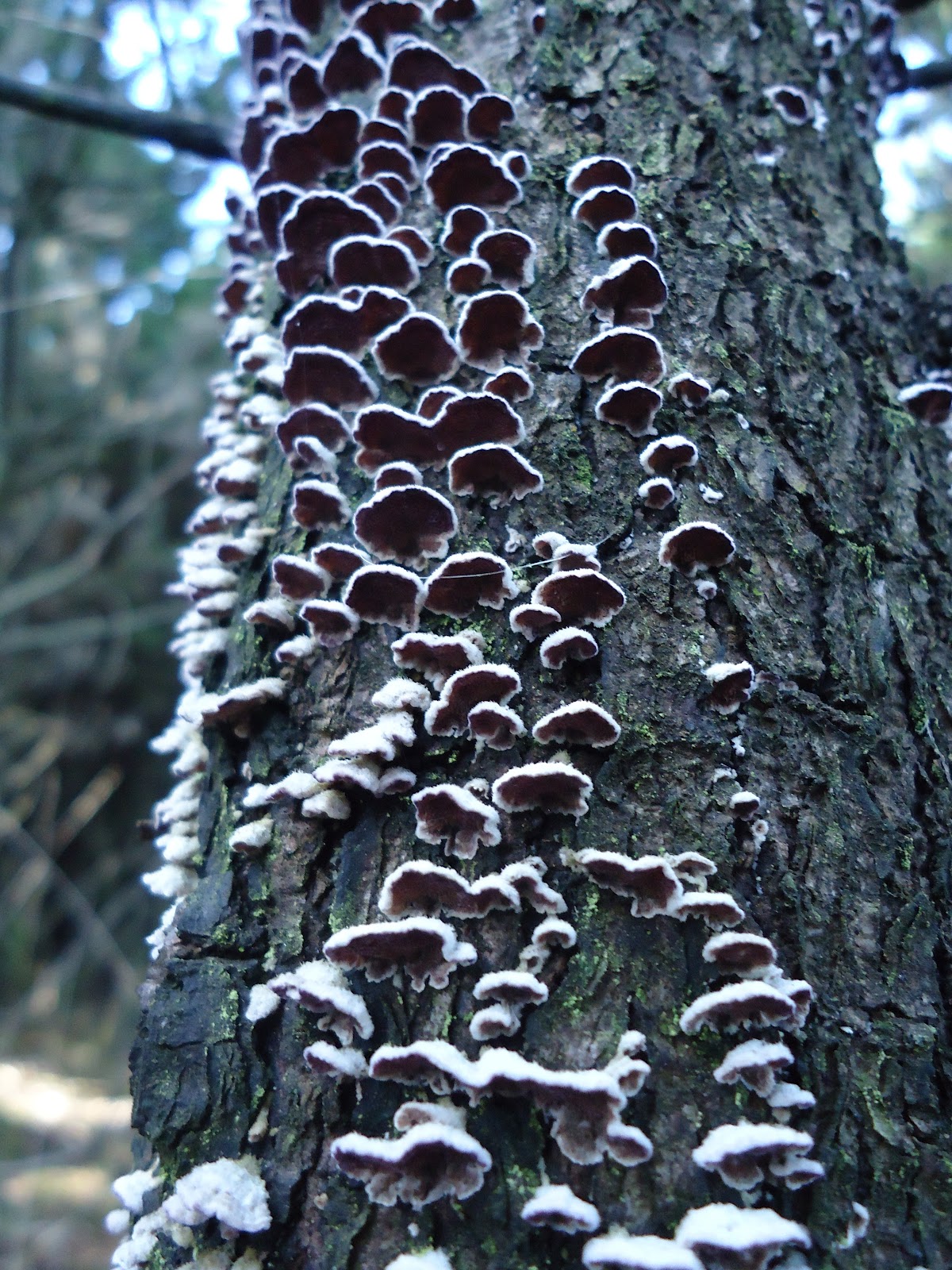
A few metres away was a Daedaleopsis confragosa, Blushing Bracket. This particular specimen looked rather healthy and I'm guessing that that all the fruiting bodies belong to one, singular fungi within this branch.
Below is the same fungi but it is young. I found this earlier but I'm sure it's the same thing. I've never seen this fungi at this developmental stage. If one looks at the edge one can see the maroon layers.
Bracket fungi take a long time to mature while Inkcaps take days. It's worth noticing the difference and learning from it.
Wednesday, 14 March 2012
Blushing Bracket
The Blushing Bracket, Daedaleopsis confragosa is a very common fungi that lives on dead wood. It forms a semicircular fan shape that can reach up to 20cms across and where it is attached to the wood can sometimes form a bump (umbo). Its uneven upper surface is maroon but with brown and ochre colours too, concentrically ridged.
The underside of this bracket consists of rounded and elongated pores which in the photo below is a silvery grey colour, however when handled or pressed on will turn pinkish then darker. The pore surface also darkens reddish brown with age. Sometimes found solitary or on tiers.
Scarlet Elf Cups at Clyne
Scarlet Elf Cups, Sarcoscypha austriaca are mushrooms that belong to a group commonly called 'cup fungi' due to their shape and are extremely easy to identify. The fungi fruits over winter and spring and in Clyne they were out in great numbers.
They live off dead deciduous wood that litter the wood floor and are usually attached to the substrate by a short stem as can be seen below. The inner surface is bright crimson and the outside a lighter shade which is the result of tiny hairs. They cap starts off in a typical cup shape but they can flatten out and become more tattered as they mature.
The photo below shows some tiny insects called Collembola, which feed off organic matter, including fungi.
Kilvey Hill. 26th Feb
On the way to kilvey hill, growing on a mound of wood mulch were loads of Stump Puffballs, Lycoperdon pyriforme, (above). I didn't expect to find much but there are always crusts about and other bracket fungi.
Below is Velvet shank, Flammulina velutipes.
Looking rather healthy was a lovely display of Purplepore Bracket, Trichaptum abietinum. This bracket is easy to identify due to its striking purple pore surface. This becomes more brown with age.
Friday, 9 March 2012
Flammulina velutipes/Velvet Shank
Flammulina velutipes or Velvet Shank to give it its common name is one a handful of fungi that fruit over winter and is easily identifiable.
The cap is a tan-yellow orange that's darker towards the centre. Although there are no photos here, the stalk is yellow at the apex but gets darker towards the base and is very velvety. It lives on decaying deciduous trees.
The first two photos were taken on 24th of February. the second two ten days later and one can see how the mushrooms have matured. These mushrooms are edible but rather flabby in texture and not really worth picking.
February 2012
There are not many fungi to be found over winter but there are a few about. In foxhole I found a great display of Trametes versicolor/Turkeytail..
Living off dead birch wood was a large Piptoporus betulinus/Birch Polypore..
Still in the same place off Kilvey Road was Geastrum triplex/Collared earthstar. The fruit bodies of this fungi is very resilient.
Living off dead birch wood was a large Piptoporus betulinus/Birch Polypore..
Still in the same place off Kilvey Road was Geastrum triplex/Collared earthstar. The fruit bodies of this fungi is very resilient.
Tuesday, 22 November 2011
Tricholoma focale/Booted Knight
About four years or so I came across a mushroom that I could not identify. Indeed I could not identify which family it belonged to. It seemed to be Cortinarius but also Agaricus. I could not find it any book and left it with a sense of frustration.
The mushroom did not fruit again until this year in exactly the same place as before and this time after photographing it I asked others via fungi groups on Facebook for help; within the hour several people came back with the same answer Tricholoma focale/Booted Knight.
One of the problems is that in one book it is not listed at all and in another, the photograph looks nothing like what I found and states that it's only found in Caledonia forests which hampered things. In Bons' book, (which is now out of publication) it is listed and actually does look like the mushroom I picked so it's worth keeping all those old books.
One of the most interesting aspects of this mushroom for me is its colour. The stipe is scaly with orange/brown tones and it also has ring remnants. The cap is domed and lustrous with a bronze sheen over orange and brown. Many thanks to those mycologists who helped me out.
Monday, 21 November 2011
Kilvey Hill 19-11-11
It's been almost a month since I went up Kilvey Hill and did a full search, going to parts of the hill that I've never ventured too before which bore some surprising finds. On the way to the hill I came across Mycena vitilis/Snapping Bonnet (above) and Tricholoma fulvum/Birch Knight, (below). This Knight has a very long stipe that goes deep into the soil.
Also on the way were two more Tricholomas, T.focale and Tricholoma scalpturatum/Yellowing Knight, the photo below is of Tricholoma scalpturatum. It fruits in the same place every year at the bottom of Kilvey Road but this year in numbers I couldn't count.
Below is a Cortinarius but there are so many in this family (at least 600) that identification is near impossible.
Another Knight, this time Tricholoma equestre/Yellow Knight. It's a regularly fruiting fungi here and stands out a mile since it's one of only two yellow Knights.
And another Knight this one is Tricholoma focale.
Along one path was Peziza badia/Bay Cup,. This was the first time that I've ever seen it in such numbers. This year for some reason there seems to have been a glut of particular species. What struck me about these was their size. They were particularly large.
On a path that I have never taken before I came across an area of land where the trees were less dense and the ground covered in moss, amongst the moss was this very small Mycena..at least that's what I think it is at the moment.
On the Port Tennant side of Kilvey Hill there are places where wood chip has been left under the trees. Tree bark mulch is favorable to many species of fungi and here, covering many square feet were a variety of 'woodchip' fungi. Below is Hypholoma marginatum/Snakeskin brownie. In the front is Pluteus cervinus/Deer Shield.
On the way down and home I also came across Collybia butyracea/Butter cap, here in a fairy ring.
And finally Amanita muscaria/Fly agaric. It's worth saying here that where I found this was severly damaged by fire earlier in the year and I feard that this mushroom would suffer as a result but not so. In fact there were many out and curiously all found on the Port Tennant side of the hill.
Subscribe to:
Posts (Atom)